SETBP1 Genetics: Bite-Sized Breakthroughs — SETBP1-Related Disorders
SETBP1 Genetics: Bite-Sized Breakthroughs — SETBP1-Related Disorders
New Publication Identifies a Third, Distinct SETBP1-Related Neurodevelopmental Disorder
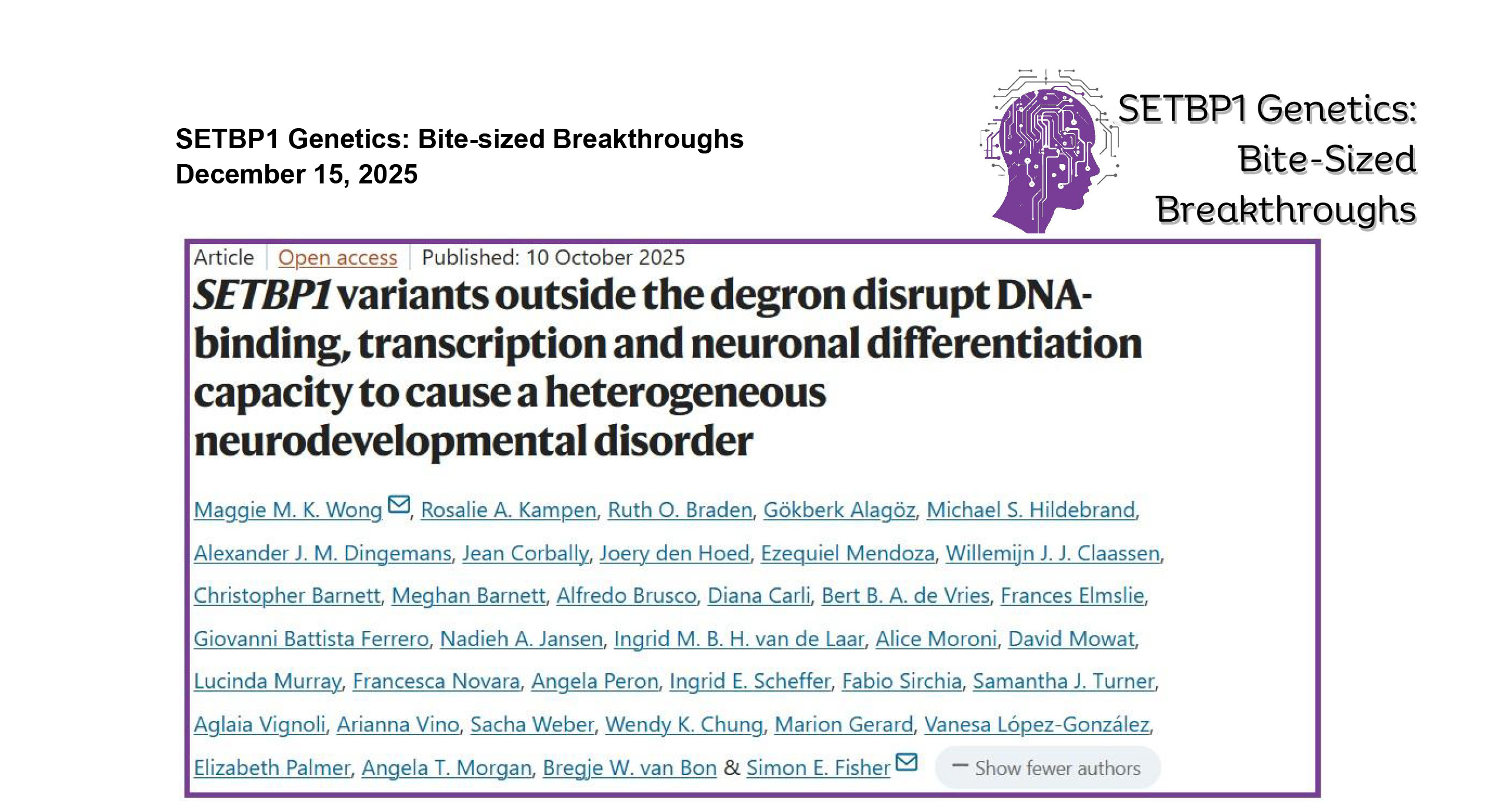
We are excited to share the latest installment in our SETBP1 Genetics: Bite-Sized Breakthroughs series — where we translate SETBP1-related scientific publications into clear, accessible summaries for our community. This month’s featured paper represents a major advancement in the understanding of SETBP1-related neurodevelopmental disorders and clarifies something the SETBP1 Society has been discussing for several years: a third, distinct condition within the SETBP1 spectrum.
For many years, SETBP1 genetic changes have been grouped primarily into two diagnostic categories: SETBP1 haploinsufficiency disorder (SETBP1-HD) and Schinzel-Giedion Syndrome (SGS). Each of these conditions is defined largely by the impact of the variant on SETBP1 protein levels. However, a growing number of families and clinicians have observed presentations that do not fit neatly into either category. The newly published study highlighted in this edition addresses this gap directly.
A Newly Defined Category: SETBP1-Related Disorder (SETBP1-RD)
The authors present the most comprehensive evaluation to date of individuals whose SETBP1 variants do not align with the established patterns of SETBP1-HD or SGS. Their work supports the recognition of a third, distinct condition now referred to as SETBP1-related disorders (SETBP1-RD). Unlike the other two disorders, SETBP1-RD is driven by loss-of-function mechanisms that are independent of SETBP1 protein quantity. Instead, the location and type of variant inform the biological effect and clinical presentation.
This distinction provides clarity for families whose children have long fallen into a diagnostic “gray area.” It also marks the first time this concept has been formally documented in a peer-reviewed publication—an important milestone for both clinical practice and scientific research.
Why Variant Information Matters
The findings in this study reinforce why SETBP1 Society emphasizes collecting detailed variant information through our Contact Registry. Having the specific SETBP1 change allows researchers to more accurately classify individuals, identify common pathways, and connect families with similar variants. Granular genetic information is increasingly crucial as the field moves toward more personalized approaches in research and, ultimately, in potential therapeutic development.
What This Means for Families and the SETBP1 Community
For many families, this publication may help explain why their child’s clinical features have not matched what is typically seen in SETBP1-HD or SGS. Having terminology that better reflects their child’s underlying biology can support more accurate communication with clinicians, more tailored care planning, and greater alignment with ongoing research.
More broadly, recognizing SETBP1-RD as a distinct condition strengthens the scientific foundation needed to improve diagnosis and natural history studies. It also highlights the growing understanding that SETBP1-related neurodevelopmental conditions exist along a wider and more nuanced spectrum than previously known.
Read the Full Bite-Sized Summary
Our summary distills the key findings of this publication into an approachable overview that highlights what is most relevant for families and the broader community.
Download the full Bite-Sized Breakthrough (PDF):
https://www.setbp1.org/wp-content/uploads/2025/12/Bite-Sized_Breakthroughs_2025_12_15.pdf
About the Bite-Sized Breakthroughs Series
The Bite-Sized Breakthroughs series is part of SETBP1 Society’s commitment to making scientific progress understandable and accessible. As research accelerates, we remain dedicated to ensuring families have the information and tools they need to stay informed and engaged.