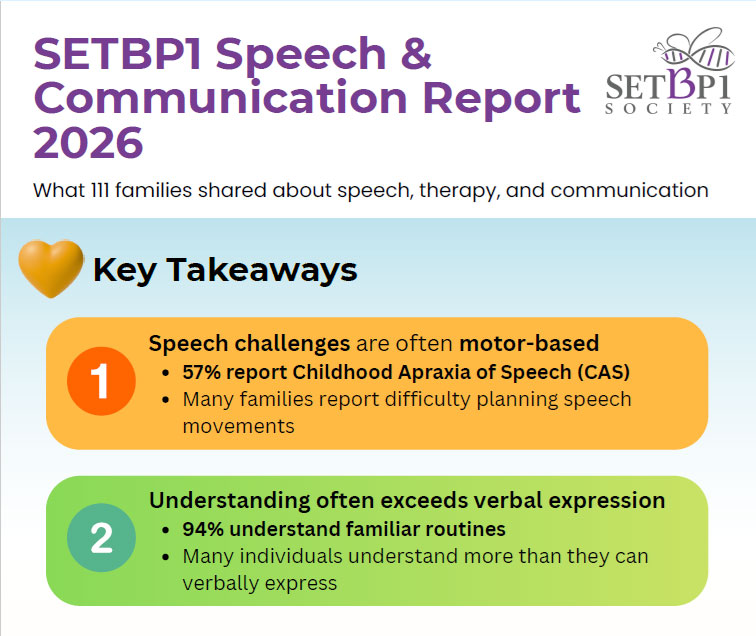
New Parent Speech & Communication Survey Results Report Now Available
The SETBP1 Society is excited to share the launch of our new Parent Speech & Communication Survey Results Report, created from responses provided by families across the global SETBP1 community.
In early 2026, 111 parents and caregivers participated in this community survey, sharing their experiences, challenges, insights, and successes related to speech, language, AAC, and communication development in individuals with SETBP1 conditions.
The report includes responses from SETBP1 Bees ranging in age from 1 to 41 years old and highlights the wide range of communication profiles seen across our community.
What’s Included in the Report?
The report features:
- Summary findings and trends from the survey
- Parent and caregiver suggestions
- Communication supports families found helpful
- Approaches that did not work well for some individuals
- Information about AAC, gestures, speech development, and multimodal communication
- Speech and communication profiles across different ages and abilities
- Community perspectives and lived experiences
We hope this report helps families, therapists, educators, clinicians, and researchers better understand the diverse communication journeys within the SETBP1 community.
Available in Multiple Languages
To help make this resource accessible to more families worldwide, the report is available in 6 languages, including English.
Available languages:
- English
- Dutch
- French
- German
- Italian (coming soon)
- Portuguese
- Spanish
Check Out the Survey Report
You can view the survey report here:
- English Report->
- Dutch Report->
- French Report->
- German Report->
- Italian Report (coming soon)
- Portuguese Report->
- Spanish Report->
If your website supports automatic language detection, visitors can also be redirected to the version that matches their selected website language.
Thank You to Our Community
A huge thank you to every parent and caregiver who took the time to participate in this survey and share your experiences. Your contributions are helping build a stronger understanding of communication development in SETBP1 haploinsufficiency disorder and related disorders and will help guide future family resources, research, and clinical discussions.
We are grateful to our entire SETBP1 community for continuing to share knowledge, support one another, and help advance understanding together.